
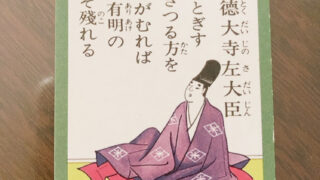




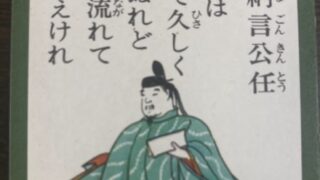

見せばやな 雄島のあまの 袖だにも 濡れにぞ濡れし 色は変はらず
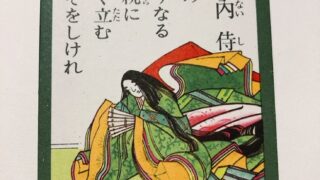
殷富門院大輔 (113?-1???)
百人一首 九十番 恋
「千載集」
かな
みせばやな をじまのあまの そでだにも ぬれにぞぬれし いろはかはらず
「いろはかはらず」は「いろは(wa)かわらず」と読みます。
Misebaya na / Ojima no ama no / Sode dani mo / Nure ni zo nureshi / Iro wa kawarazu
言葉の意味
見せばやな:見せたいものです。かなりカジュアルな言い方だと「見せてやりたい」になります。
I want to show [it to you]. In a very casual way, it means “I want to let you see it.”
雄島の:雄島の Of Ojima
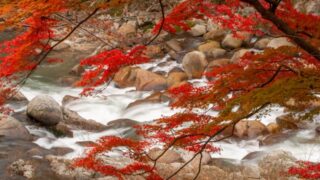
雄島は現在の宮城県松島にある島です。松島は古くから美しい場所として有名でした。
Ojima is an island located in Matsushima, current Miyagi Prefecture. Matsushima has been famous as a beautiful place since ancient times.
あまのそでだにも:漁師の袖でさえも
Even the sleeves of the fishers.
濡れにぞ濡れし:濡れに濡れて
「濡れた」を強調する表現です。「極限まで濡れました」というような意味です。
「袖が濡れる」「袖を濡らす」は、「泣く」のメタファーです。
Being completely drenched.
This is an expression that emphasizes “being wet.” It carries a meaning like “wet to the absolute limit.” “Sleeves getting wet” or “wetting one’s sleeves” is a metaphor for “crying.”
色は変はらず:色は変わらないでしょう。
この歌では「漁師の袖さえも、色までは変わらないでしょう。私の袖は、涙が枯れて血の涙で染まっています。」という意味で使われています。
The color will probably not change.
In this poem, it is used to mean, “Even the fishers’ sleeves, their color at least would not change. But my sleeves are stained with tears of blood, as my regular tears have run dry.”
現代語訳
見せたいものですね。雄島の漁師の濡れに濡れている袖ですら、こんな色にはなっていません。(涙が枯れて、血の涙で私の袖は染まっていますよ。)
I want to show it to you. Even the completely drenched sleeves of the fishers of Ojima do not turn into a color like this. (My tears have run dry, and my sleeves are stained with tears of blood.)
「袖の色が赤くなっている」「血の涙を流している」とは、はっきり書かれていませんが、古典では「袖の色が変わる」は「血の涙で赤くなっている」という意味で使われています。これは中国の古典から来た表現です。怒り、悔しさ、悲しさなどの感情が普通ではないくらいに激しいというときに使うメタファーです。現代でも小説やXのポストで見ることがあります。
It is not explicitly written that “the color of the sleeves has turned red” or “I am crying tears of blood.” However, in the classical literature of this era, “the color of sleeves changing” was used to mean “being turned red by tears of blood.” This is an expression derived from Chinese classics. It is a metaphor used when emotions such as anger, regret, or sadness are intensely unusual. You can sometimes see it in novels or posts on X.
「ちょっとこの袖を見てほしいですね。あなたのことを想うあまりこんな状態になっていますよ。袖が赤くなってますよ。」というようなことをこの歌は言っています。現代の私たちから見ると、血の涙で袖が染まるとは穏やかではない表現ですね。
This poem is saying something like, “I’d really like you to take a look at these sleeves. Because I think of you so much, they have ended up in this state. The sleeves have turned red.” Looking at it from our modern perspective, staining one’s sleeves with tears of blood is quite an intense expression, isn’t it?
この歌は、10世紀後半に作られた下の歌の、今で言うアンサーソングのような歌です。
This poem is what we would call today an “answer song” to the poem below, which was composed around the late 10th century.
松島や 雄島の磯に あさりせし あまの袖こそ かくは濡れしか 源重之
Matsushima ya / Ojima no iso ni / Asari seshi / Ama no sode koso / Kaku wa nureshi
おお、松島よ。雄島の磯で漁をしている漁師の袖なら、私の袖と同じぐらい濡れているだろう。
Oh, Matsushima. The sleeves of the fishers who were fishing on the shores of Ojima must be just as wet as mine.
ところで、私は2022年1月から百人一首の記事を書いていて、この歌で52首目になります。ここまで記事を書いていて気づいたことがあります。
始めのころは、「つらい気持ちだったんだな」とか「ストレートな気持ちなんだな」などと、ピュアな気持ちで読んでいました。
でも、百人一首には「ノリで詠んでいる」歌もかなりある。
「ノリで詠んでいる」とはどういうことかと言うと、「その場の雰囲気に流されて」とか、「このような歌を詠めばウケるだろうなどと考えて」詠んでいるということです。もちろん、和歌は気持ちを表す手段です。しかし、宴会 (banquet) のような歌会 (poetry gatherings) で詠まれることもあり、宴会芸のひとつでもありました。
大勢の人が聞いていると、話や表現が大げさになることはよくありますね。
By the way, I have been writing articles on the Hyakunin Isshu since January 2022, and this poem marks my 52nd article. Having written articles up to this point, there is something I have noticed.
In the beginning, I used to read the poems with pure feelings, thinking things like, “They must have been going through a painful time,” or “These are such straightforward feelings.”
However, in the Hyakunin Isshu, there are quite a few poems composed just “for the vibe” (nori).
What I mean by “composed for the vibe” is that they were composed while “being carried away by the atmosphere of the moment,” or “thinking that writing this kind of poem would be well-received by the audience.” Of course, waka poetry is a means of expressing feelings. However, they were sometimes composed at poetry gatherings that were like banquets, serving as a kind of banquet performance. When a lot of people listen to you, it is very common for stories and expressions to become exaggerated, isn’t it?
この歌の作者、殷富門院大輔 は宮廷の高級女官 (high ranking court lady) で、一流の歌人です。そのような女性が古い時代の有名な歌のアンサーソングを、中国の古典から来た大げさな表現を使って詠んでいる。これは人に見せるために詠んだ歌であると言っていいでしょう。
殷富門院大輔は12世紀に生きた人ですが、7世紀ごろの和歌の聖人 (saint)、柿本人麻呂の法要 (Buddhist memorial service) を行ったこともあります。「法要を行う」、どういうことかわかりにくいと思いますが、この法要は今で言う推し活です。
会ったこともないのに法要を行うくらい柿本人麻呂のことを推していた。おもしろい女性だったんだなと思います。
The author of this poem, Inpumon’in no Taifu, was a high-ranking lady-in-waiting at court and a first-rate poet. When such an author writes an answer song to a famous poem from an older era using an exaggerated expression derived from Chinese classics, we can safely say that this poem was composed to be shown off to others.
Inpumon’in no Taifu lived in the 12th century, but she once held a hoyo (Buddhist memorial service) for Kakinomoto no Hitomaro, a saint of waka poetry from around the 7th century. It might be hard to understand what the act of “holding a memorial service” means, but this memorial service is what we would call oshi-katsu (supporting your favorite) today.
She supported Kakinomoto no Hitomaro so much that she held a memorial service for him even though she had never met him. I think she must have been an interesting woman.
表現
~ものです/~ものだ 使い方が3つあります。
・一般的な真理、ルール、道徳を教えるときに使います。
Used when teaching general truths, rules, or morals.
子どもは泣くものです。
人は間違えるものです。
自分のゴミは持ち帰るものです。
人の悪口は言うものじゃありません。
・なつかしい気持ちで昔よくしたことを話すときに使います。
Used when talking about things you used to do often in the past with a sense of nostalgia.
昔はよく一緒に来たものだね。
子どもの時はよくこのゲームをしたものだ。
・深い感動や気持ちを表します。「~なあ」とほぼ同じです。
Expresses deep emotion or feelings. It is almost the same as “〜なあ” (naa).
月日がたつのは早いものですね。
見せたいものですね。
V(ます)にV-ている
大雨で服が濡れに濡れている。
この商品は売れに売れている。
のりにのっているアイドル。
「とてもV-ている、普通でないぐらいV-ている」という意味です。
この表現はJLPTではあまり出ることはありません。また、使える動詞が限られているので、文章の中で見たときに、なんとなく意味がわかればだいじょうぶです。
It means “doing V very much” or “doing V to an unusual degree.” This expression rarely appears on the JLPT. Also, since the verbs that can be used are limited, it is perfectly fine if you can vaguely understand the meaning when you see it in a sentence.
V-るあまり/Noun のあまり
彼女のことが気になるあまり、東京まで来てしまった。
駅に行こうと急ぐあまり、財布を忘れてしまった。
悔しさのあまり、ごみ箱を蹴り飛ばしてしまった。
うれしさのあまり、眠れなかった。
「とても~から」という意味です。後ろの部分には、「そうしようとは思っていなかったのに、してしまった」というような表現が来ることが多いです。
It means “because it is very…”. In the latter part of the sentence, expressions meaning “I ended up doing something, even though I hadn’t intended to” often follow.
ノリ:これは会話でよく使います。
ノリがいい:be so much fun, be outgoing, be a good sport
明るくてその場の雰囲気を盛り上げられる性格について使います。
Used for a personality that is bright and can liven up the atmosphere of the place.
ノリが悪い:kill joy, party pooper, buzzkill
その場の雰囲気を壊すような行動、性格について使います。
Used for actions or personalities that ruin the atmosphere of the place.
その場のノリでつい、~してしまった:did ~ on the spur of the moment, I just went with the flow.
普通だったら~しないけど、その場の雰囲気で~してしまったという時に使います。
Used when you did something due to the atmosphere of the place, even though you wouldn’t normally do it.
その場のノリで詠んだ歌:A poem composed on the spur of the moment.
その場の雰囲気に合わせて詠んだ歌。その場を盛り上げるために詠んだ歌。
A poem composed to match the atmosphere of the place. A poem composed to liven up the place.
ノリノリだね:You are in high spirits today! You’re kind of hyper today!
とても楽しそうに音楽を聞いていたり、イベントに参加している人に言います。
Said to someone who looks very happy listening to music or participating in an event.
ノリノリな音楽:upbeat songs, songs with a good beat
明るくて楽しくなるような音楽 Bright and fun music.
大げさ:exaggerated
大げさな表現:Exaggerated expressions
A: 私は世界一不幸だ。I’m the unhappiest person in the world.
B: 大げさじゃない? Isn’t that a bit of an exaggeration?
推し活:最近よく聞く言葉です。推し (アイドル、歌手、俳優、スポーツ選手、アニメやゲームのキャラクターなど、好きな人やキャラクター) を応援する活動のことです。ライブに参加したり、グッズを買ったりして推しを応援します。
推しがいることで癒される。推し活をすることで仕事や勉強をがんばることができる、推しに見合う自分になるためにおしゃれをするようになる、などの効果があるようです。
This is a word heard often lately. It refers to activities to support your oshi (your favorite person or character, such as idols, singers, actors, athletes, anime or game characters). People support their oshi by attending live concerts or buying merchandise. It seems to have positive effects, such as being healed by having an oshi, being able to work or study hard by doing oshi-katsu, or starting to dress up to become a person worthy of their oshi.
2年ほど前、私の生徒さんに読み応えがあると思ってもらえるようなものを書きたいと思っていました。私の生徒さんには、「源氏物語」や「枕草子」などの古典が好きな人が多いので、じゃあ古典をテーマにしようと思って書き始めました。百人一首なら100記事書けると軽く考えていたのですが、意外と大変で、やめたくなることもありました。文章を書くのは好きなのですが、人に見せるための文章は、ちょっと大変ですね。やっと半分書けました。
でも、生徒さんから感想をもらえるとうれしくて、続けられています。アクセスの多くないブログですが、いろいろな国の人が読んでくれていて、とても励みになります。
今日もここまで読んでくれてありがとうございました。
About two years ago, I wanted to write something that my students would find worth reading. Since many of my students like classical literature such as The Tale of Genji and The Pillow Book, I thought, “Well then, let’s make classical literature the theme,” and started writing. I thought lightly that I could write 100 articles if it was the Hyakunin Isshu, but it was unexpectedly difficult, and there were times I wanted to quit. Although I like writing sentences, it’s a bit tough when it comes to writing text meant to be shown to others. However, I have finally written half of them.
Even so, I am happy when I get feedback from my students, which keeps me going. It is a blog without much traffic, but people from various countries are reading it, which is very encouraging.
Thank you very much for reading this far today as well
このページのサムネイル画像は、素材サイトのイラストACからダウンロードしたものです。SHIEDAさんという方のイラストを使っています。
令和八年六月四日